 Stella
 connected token swaps, liquidity provision and governance on Moonbeam before closing
Stella, known as StellaSwap, was a decentralized exchange that used liquidity pools for token trading on Moonbeam. It ended operations on 31 July 2026, so it no longer offered an operating exchange for new trades. During its life, the protocol combined standard, stable-asset and concentrated-liquidity pools. It also offered liquidity incentives, STELLA-based governance, cross-chain access and liquid-staking products. Those components addressed different tasks and carried different constraints: a swap exchanged assets, a liquidity position supplied assets for trades and a governance lock directed incentives. Its historical product names help distinguish older balances and transactions, including positions that followed different withdrawal rules.
Shared Liquidity Behind Token Trades
StellaSwap's automated market makers used deposited assets to support token exchanges, with pool designs that distributed liquidity differently. An automated market maker, or AMM, priced trades through smart contracts. Liquidity providers supplied the assets that those contracts made available for exchange. The pool design affected how effectively deposited capital supported trades around a particular market price.
Standard pools spread liquidity across the price curve. Stable pools focused on assets whose values were expected to remain closely related. Concentrated liquidity let providers select price intervals. These designs addressed different pricing conditions within the same exchange. Swapping used available liquidity, while providing liquidity exposed a position to changes in the relative prices of its assets.
Historical Options and Their Limits
StellaSwap's products connected trading liquidity with several ways to allocate assets and rewards. These products belonged to different periods and product families. A liquidity receipt, a governance lock and a liquid-staking token represented different commitments within the former platform.
| Historical Option | Role During Operation | Exposure or Limit |
|---|---|---|
| Standard AMM V2 | Supported swaps through broadly distributed liquidity | Relative price changes altered the position's asset mix |
| Stable AMM | Supported exchanges between correlated assets | Pricing efficiency relied on closely related asset values |
| Pulsar V3 | Concentrated liquidity within selected price ranges | Out-of-range positions stopped earning trading fees |
| StellaSwap V4 | Combined a concentrated-liquidity core with plugins | Additional functions depended on pool plugin configuration |
| ICHI Single-Asset Deposits | Allocated single-token deposits through managed liquidity vaults | The vault strategy controlled asset allocation and rebalancing |
| veSTELLA | Directed pool incentives through voting locks | Voting power decayed with time; early unlocking carried a penalty |
| stDOT | Represented a share of pooled, staked DOT | Direct redemption involved DOT unbonding |
V4's plugin architecture allowed changes to an existing pool without requiring a new pool for every additional feature. ICHI vaults instead managed deposited assets within concentrated liquidity.
How Did Pulsar Change Liquidity Provision?
Pulsar gave liquidity providers control over the price range in which their assets supported trading. A narrower range concentrated the deposit around fewer prices. This could increase fee participation while the market remained inside that range, with greater exposure to leaving it.
A Pulsar position used a non-fungible token (NFT) to represent its selected pool, deposited liquidity and price bounds. Its composition changed as trades moved through the range. The deposit did not always require equal values of both assets; the selected bounds and market price determined the required proportions.
A Pulsar position outside its selected price range earned no trading fees. The position's liquidity consisted entirely of one asset in the pair.
Legacy ZAP V1 automated liquidity-provider (LP) token creation from a supported single-token deposit for pools containing that asset. Farm rewards still required depositing the resulting LP token into its corresponding farm. The later documented Pulsar deposit flow removed that separate farm-deposit step. Trading fees still depended on active liquidity and trading activity, while additional incentives depended on the applicable reward program. A concentrated position therefore needed its own pool and range context when interpreting historical earnings.
STELLA Governance and Fee Distribution
STELLA connected the exchange's liquidity incentives with governance, although the protocol used different staking models during its history. Liquidity rewards encouraged asset deposits into pools. Governance determined how incentives reached those pools. Holding the native token, receiving a liquidity receipt and locking tokens for voting had separate economic meanings.
The earlier xSTELLA facility issued a token representing a share of a shared STELLA staking pool. Swap-fee-funded buybacks added STELLA to that pool, changing the amount of underlying STELLA attributable to each share. This mechanism differed from providing a token pair as trading liquidity. The legacy xSTELLA model allowed unstaking without a timelock.
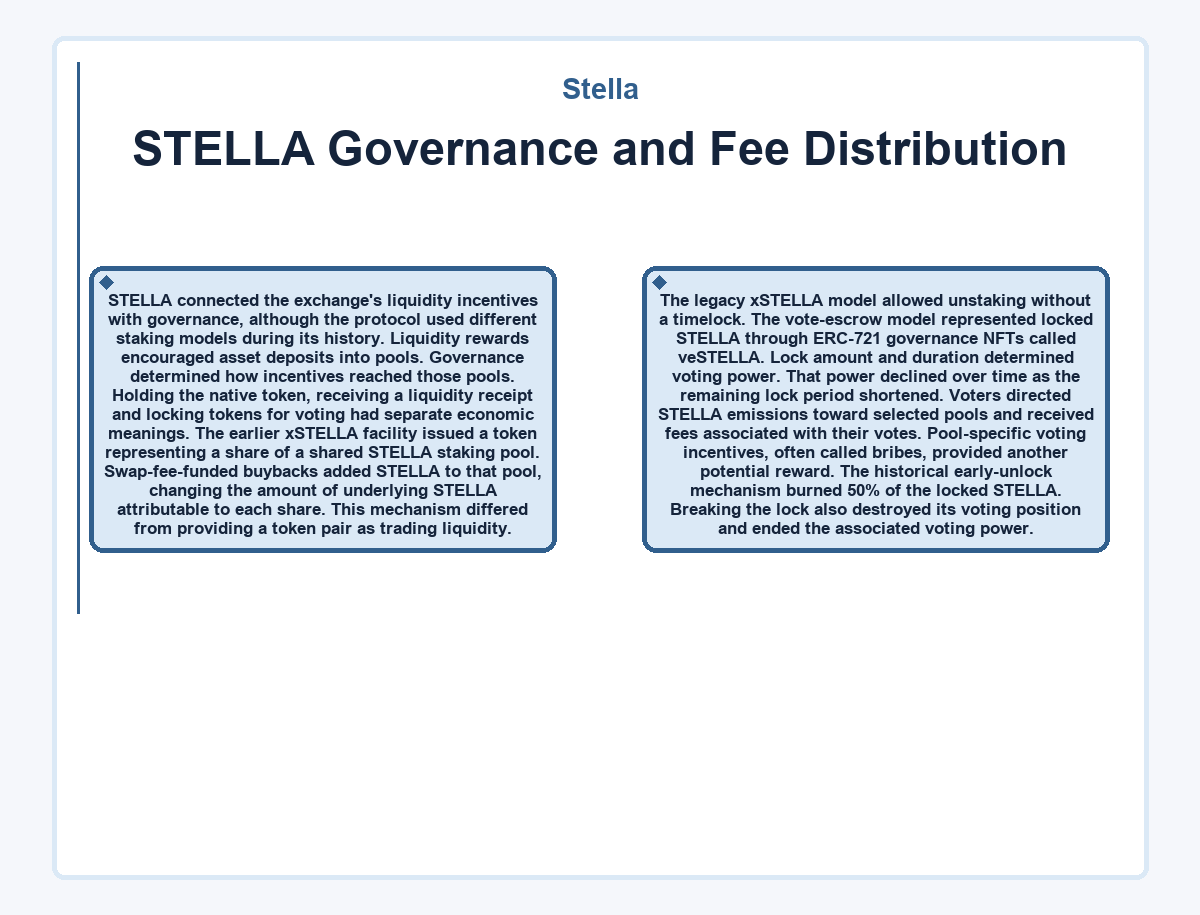
The vote-escrow model represented locked STELLA through ERC-721 governance NFTs called veSTELLA. Lock amount and duration determined voting power. That power declined over time as the remaining lock period shortened. Voters directed STELLA emissions toward selected pools and received fees associated with their votes. Pool-specific voting incentives, often called bribes, provided another potential reward.
The historical early-unlock mechanism burned 50% of the locked STELLA. Breaking the lock also destroyed its voting position and ended the associated voting power.
Cross-Chain Access and Developer Integrations
Cross-chain services extended the exchange's access beyond tokens already held on Moonbeam. A Squid integration using Axelar supported cross-chain swaps involving Moonbeam and other EVM networks. EVM means Ethereum Virtual Machine, the execution environment used by compatible smart-contract networks. Native XCM transfers addressed a different task: moving supported Polkadot ecosystem assets between chains. A transfer and a swap could therefore serve different purposes within the same interface.
The developer SDK offered a hybrid router covering stable, V2 and V3 AMMs. It exposed quoting and swap-execution functions for applications using the exchange's liquidity. A quote described expected output and a trading path; it did not establish that a trade had completed. The earlier Initial Liquidity Offering aimed to attract capital for STELLA liquidity and the protocol treasury.
Liquid Staking Alongside Exchange Pools
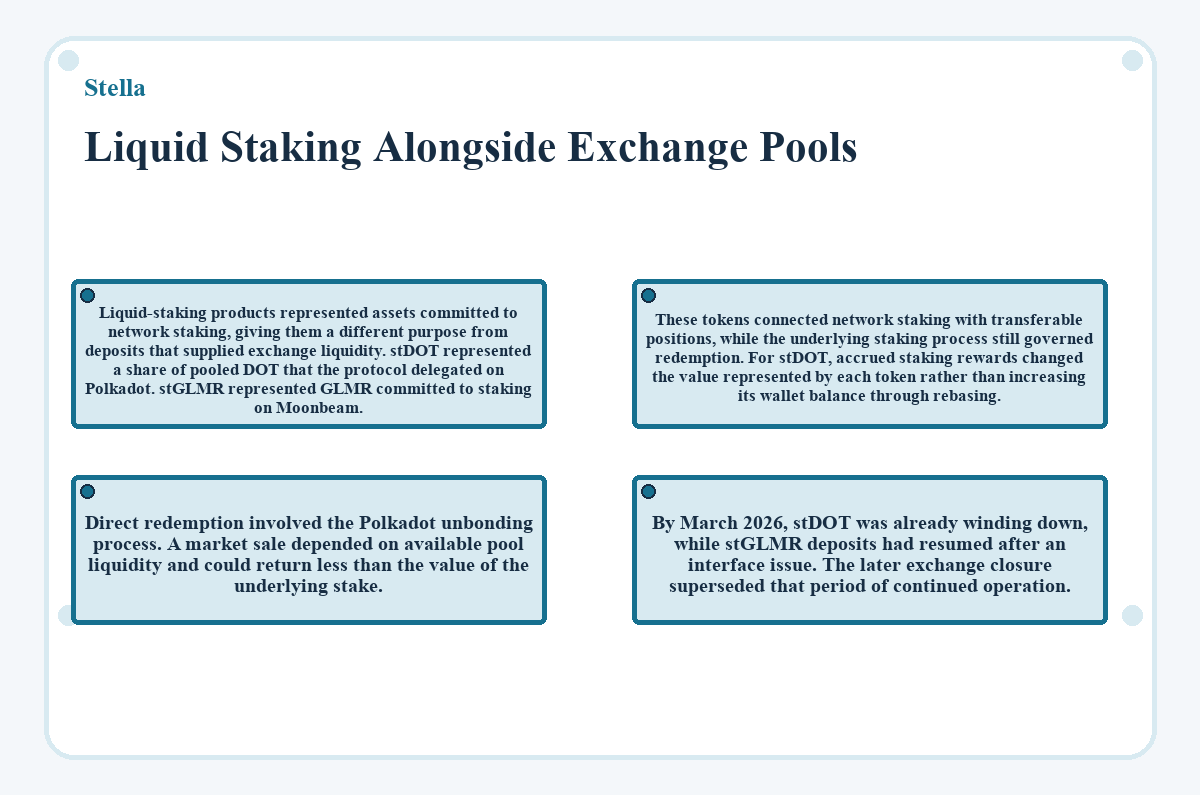
Liquid-staking products represented assets committed to network staking, giving them a different purpose from deposits that supplied exchange liquidity. stDOT represented a share of pooled DOT that the protocol delegated on Polkadot. stGLMR represented GLMR committed to staking on Moonbeam. These tokens connected network staking with transferable positions, while the underlying staking process still governed redemption.
For stDOT, accrued staking rewards changed the value represented by each token rather than increasing its wallet balance through rebasing. Direct redemption involved the Polkadot unbonding process. A market sale depended on available pool liquidity and could return less than the value of the underlying stake. By March 2026, stDOT was already winding down, while stGLMR deposits had resumed after an interface issue. The later exchange closure superseded that period of continued operation.
Is StellaSwap Still Available for New Trades?
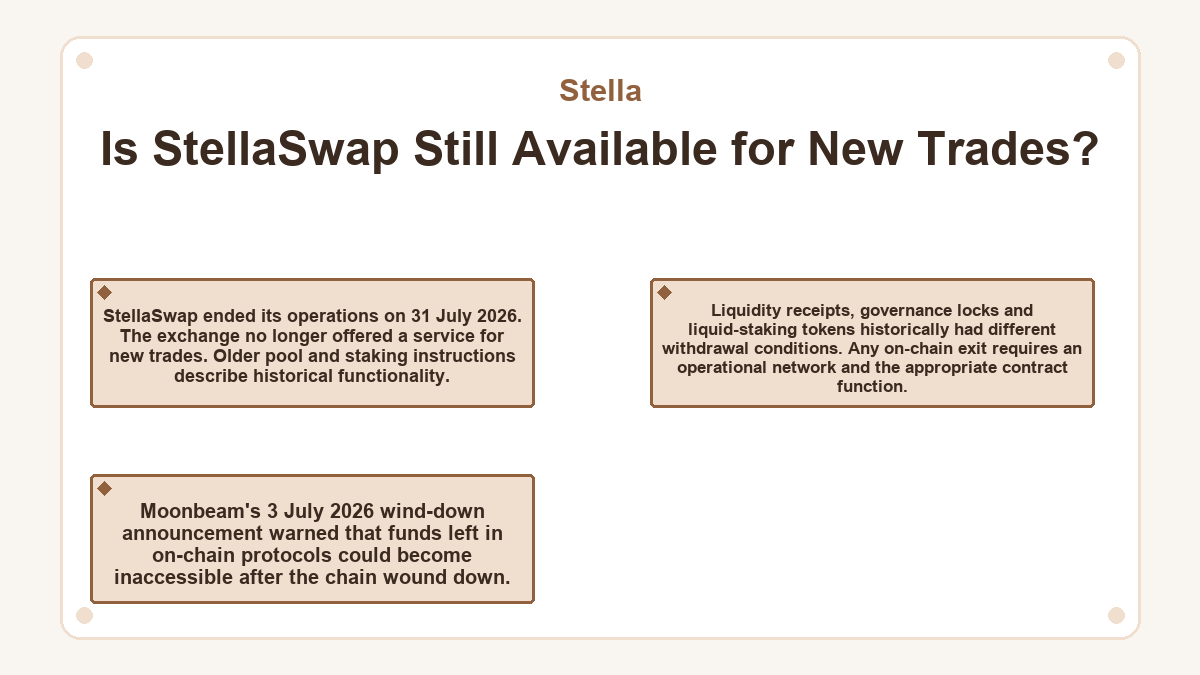
StellaSwap ended its operations on 31 July 2026. The exchange no longer offered a service for new trades. Older pool and staking instructions describe historical functionality. Liquidity receipts, governance locks and liquid-staking tokens historically had different withdrawal conditions. Any on-chain exit requires an operational network and the appropriate contract function. Moonbeam's 3 July 2026 wind-down announcement warned that funds left in on-chain protocols could become inaccessible after the chain wound down.
Questions and answers about Stella
-
When Did StellaSwap Launch on Moonbeam?
- StellaSwap launched on Moonbeam on 11 January 2022, alongside the network's full Ethereum Virtual Machine launch. Its stable AMM, Pulsar and vote-escrow model belonged to later product generations, so the launch date did not describe every feature that the exchange eventually offered.
-
Was STELLA Required to Pay Gas for StellaSwap Transactions?
- Moonbeam transactions used GLMR for gas, including interactions with StellaSwap contracts. STELLA had a separate role in the exchange's incentives and governance. Holding STELLA did not replace the native gas balance that a wallet needed to submit a transaction on Moonbeam.
-
Why Could Identically Named Moonbeam Tokens Fail to Match a Pool?
- A token's contract address distinguished its Moonbeam representation, even when several assets displayed the same symbol. Different bridges could issue separate representations of an underlying asset. A pool that accepted one contract did not automatically accept another, so a matching ticker alone could not establish compatibility.
-
Does the Shutdown Cancel Old ERC-20 Token Approvals?
- An exchange shutdown does not itself revoke an ERC-20 spending allowance. The token contract stores authorization for a particular spender; disconnecting a wallet leaves that authorization unchanged. Changing it requires a successful on-chain approval transaction, which depends on the relevant network and contract remaining operational.
-
Where Can Former StellaSwap Users Contact the Team?
- The team remains reachable through Discord, although responses may be slow. A support request does not require sharing a wallet recovery phrase or private key. Those secrets grant control over wallet assets and should never be included in a message to someone offering help with an old position.
-
Did STELLA's Maximum Supply Remain Unchanged?
- STELLA's tokenomics revision reduced the stated maximum supply from 500 million to 250 million tokens. The change involved minting and burning 250 million STELLA. These historical maximum-supply figures described the issuance limit, rather than the circulating supply or an individual wallet balance.