 Stella
Stella liquidity in Pulsar supported swaps within each position's chosen price range
Stella liquidity supplied token capital to StellaSwap's Moonbeam pools, with Pulsar deposits supporting swaps within individually selected price ranges. The exchange closed on 31 July 2026. Pulsar V3 providers chose lower and upper price bounds for individual positions. Trading fees accrued when swaps used liquidity within those bounds. A position outside its range stopped earning new swap fees and its underlying liquidity consisted of one asset. Standard pools, full-range positions and automatically managed vaults represented different approaches to supplying trading capital. A position's range determined where it could participate, while its changing token composition determined market exposure.
Pool Reserves and Active Trading Depth
Pulsar combined individual price ranges into pool liquidity, allowing swaps to use the positions that covered the traded price. Its automated market maker, or AMM, exchanged assets through smart contracts. Concentrating capital around trading prices could provide greater local depth than spreading that capital across the full price curve. That depth affected the price impact of trades passing through the range. Overlapping positions contributed together, and the active set changed as the pool price crossed their bounds. Total deposited value therefore described a different quantity from liquidity available at a particular price.
Standard V2 positions spread liquidity across the full pricing curve. StellaSwap also had stable-asset pools with a separate pool design. Full-range Pulsar positions offered broad price coverage within the concentrated-liquidity system. The narrower alternatives made capital available over a smaller interval, tying participation more closely to price movement. Pool design determined how those deposits entered trading and how the resulting position represented the supplied assets.
What Happened When a Pulsar Position Left Its Range?
An out-of-range Pulsar position stopped supplying liquidity at the prevailing pool price and earned no new swap fees. Trading through the entire interval converted its underlying liquidity into one of the pair's tokens. Which token remained depended on the boundary crossed and which token the quoted price measured. This described the assets backing the position; accumulated fees were a separate quantity. Range width and placement determined how much price movement would take the position outside its bounds.
Other positions could keep the pool trading while one provider's liquidity remained outside its selected bounds.
Returning inside the stored bounds made an unchanged position eligible to participate again while the exchange operated. Actual fee earnings still required trades that used its liquidity. Outside the interval, the position retained exposure to the token that it held, including that token's price changes. Its inactive status described participation in the AMM. It did not establish that the underlying balance had vanished or that the remaining asset would recover its previous value.
Fees and the Holding Comparison
Pulsar V3 used dynamic swap fees, so earnings reflected both trading conditions and a position's participation in the traded range. Its Algebra-based mechanism used volatility, volume and liquidity inputs. Pulsar V3 allocated position swap fees in proportion to the liquidity that each position supplied within the traded range. Choosing tighter bounds changed the concentration of a provider's capital. The pool's fee configuration governed the rate that applied to swaps.
Incentive Rewards
Liquidity incentives added a separate stream of reward tokens when a position met the applicable program's conditions. Earlier standard-pool farms paid STELLA rewards for staked LP tokens. Swap fees came from pool activity, while incentive allocations followed the reward arrangement. Those streams could have different eligibility rules and token denominations. A reward's token quantity also differed from its market value, which changed with the reward token's price.
Position Performance
Changing Token Composition
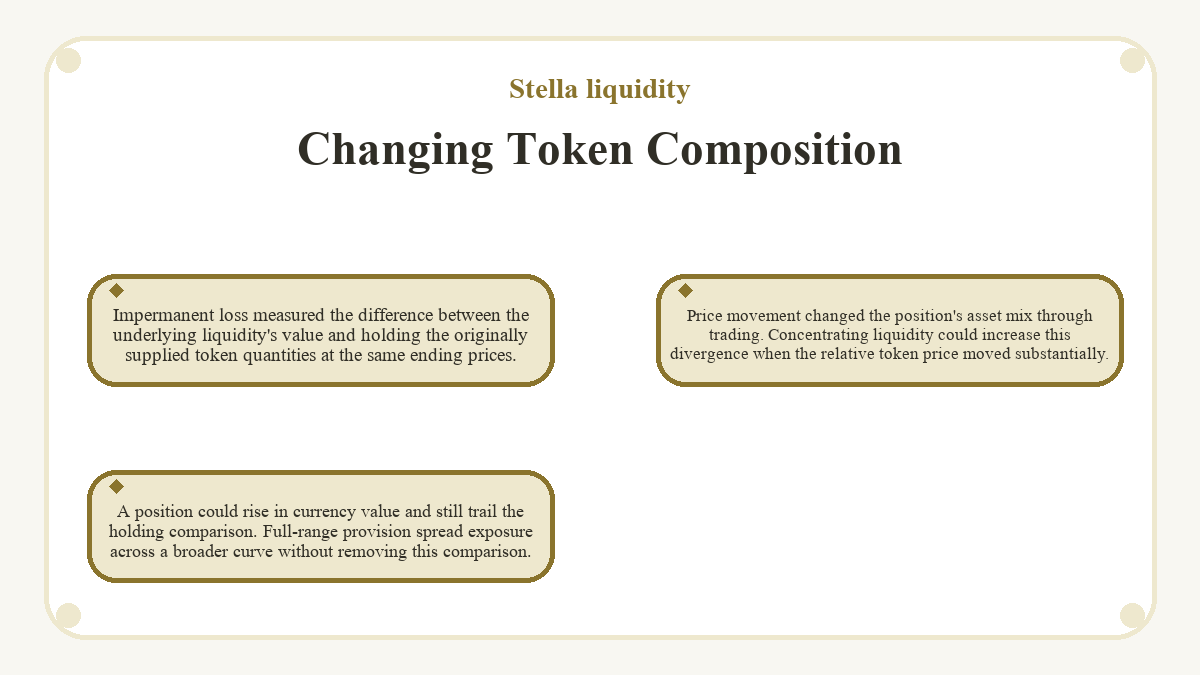
Impermanent loss measured the difference between the underlying liquidity's value and holding the originally supplied token quantities at the same ending prices. Price movement changed the position's asset mix through trading. Concentrating liquidity could increase this divergence when the relative token price moved substantially. A position could rise in currency value and still trail the holding comparison. Full-range provision spread exposure across a broader curve without removing this comparison.
Transaction Costs and Earned Tokens
Fees and incentive receipts contributed to total proceeds, while liquidity changes incurred Moonbeam transaction gas. Manual Pulsar transactions used GLMR for that gas cost. Comparing performance required a consistent valuation currency and period for the position, reward receipts and original holdings. Collected fees and still-pending fees were different amounts, so adding them required accounting for each once. A completed manual liquidity change incurred gas even if the replacement position later earned no swap fees.
Keeping or Rebuilding a Legacy Range
Before closure, retaining a manual Pulsar position kept its existing bounds without a rebuild. Reconstructing an out-of-range position could bring its capital into an interval containing the pool price. Those alternatives differed in token composition and transaction costs. The position's non-fungible token, or NFT, represented its liquidity. The pool price identified the range state, while farm custody affected access to that NFT.
- Match the position to its pool and read its stored lower and upper bounds.
- If the pool price remained inside those bounds, retaining the position preserved its participation without creating a replacement.
- If the price sat outside, compare waiting for re-entry with removing liquidity, obtaining the token amounts required by the new range and supplying them within those bounds.
- If a farm held the NFT, the rebuild flow required withdrawing it from the farm before removing its liquidity.
- For a replacement, confirm that the supply transaction succeeded and check the new position NFT's bounds before treating the rebuild as complete.
An approval granted the required contract permission; a successful supply transaction created the replacement position. A pending supply transaction did not establish a completed rebuild. The new NFT represented the supplied position, while its in-range status depended on the pool price at inspection.
Ticks and Position Ownership
Pulsar V3's legacy range grid used 60-tick spacing, restricting which lower and upper bounds a position could use. Ticks indexed proportional price changes along the pool's curve. A spacing of 60 ticks therefore did not mean a fixed distance in currency units. Broader positions could span many intervals on the grid.
Price Bounds
A position's lower and upper ticks identified its interval on that grid. Displayed bounds needed a consistent order for the pair's tokens to preserve their meaning. The pool's price relative to the bounds described trading participation. The quantity and value of deposited tokens described capital exposure. A narrow range label did not specify either a fixed deposit value or a fixed return.
Position Tokens
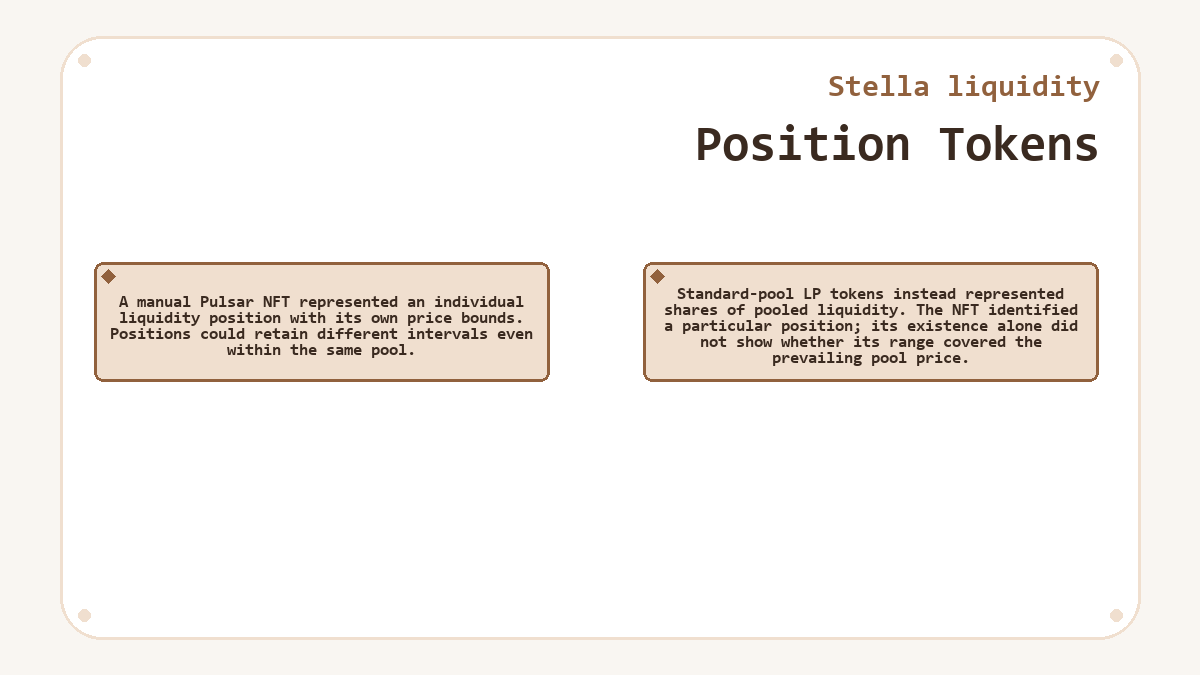
A manual Pulsar NFT represented an individual liquidity position with its own price bounds. Positions could retain different intervals even within the same pool. Standard-pool LP tokens instead represented shares of pooled liquidity. The NFT identified a particular position; its existence alone did not show whether its range covered the prevailing pool price.
Manual Ranges and Automated Vaults
StellaSwap's ICHI vaults accepted a single deposit asset and managed its allocation to concentrated liquidity through automated rebalancing. Single-asset entry described the deposit input; the managed position could contain both pool tokens. This differed from a manual position whose provider selected individual bounds. Automatic management changed who adjusted the allocation; it did not establish a fixed return from deposited capital.
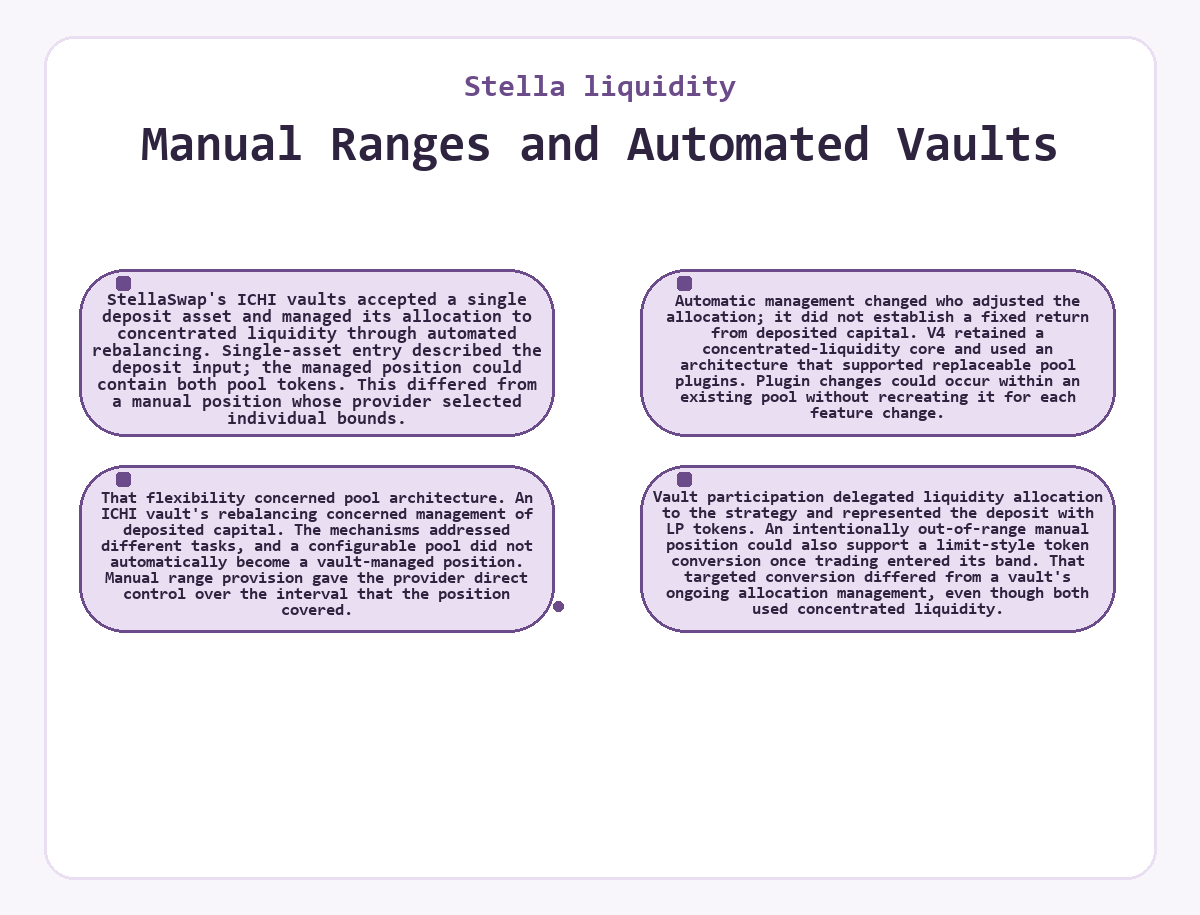
V4 retained a concentrated-liquidity core and used an architecture that supported replaceable pool plugins. Plugin changes could occur within an existing pool without recreating it for each feature change. That flexibility concerned pool architecture. An ICHI vault's rebalancing concerned management of deposited capital. The mechanisms addressed different tasks, and a configurable pool did not automatically become a vault-managed position.
Manual range provision gave the provider direct control over the interval that the position covered. Vault participation delegated liquidity allocation to the strategy and represented the deposit with LP tokens. An intentionally out-of-range manual position could also support a limit-style token conversion once trading entered its band. That targeted conversion differed from a vault's ongoing allocation management, even though both used concentrated liquidity.
Things people ask about Stella liquidity
-
Could a Pulsar Pool APR Predict Earnings for Every Position?
- A historical pool annual percentage rate (APR) could not predict the earnings of every individual Pulsar position. The pool calculation used fees generated over 24 hours and active total value locked, or TVL. Individual earnings reflected the position's range, liquidity share and participation during the measured period. The pool figure annualized past activity; it did not establish a fixed future payout.
-
Did Manual Pulsar Deposits Always Need Equal Token Values?
- Manual Pulsar deposits did not always require equal values of the two tokens. The deposit ratio depended on the selected bounds and the pool price relative to those bounds. The legacy manual flow calculated the amounts for the position. Equal token counts also differed from equal token values, so neither ratio should be inferred from the pair's name.
-
Was Separate Farm Staking Required for Every Pulsar Incentive Program?
- Pulsar reward arrangements did not all require a separate farming step. Older instructions included NFT positions deposited in farms, while an updated manual-deposit flow removed separate farming before rewards began. Eligibility still followed the applicable incentive arrangement. Removing that extra step did not make an out-of-range position eligible for rewards that required active liquidity.
-
Which Assets Did the Legacy ZAP-out Flow Return for two-asset LP Tokens?
- The legacy ZAP-out flow for two-asset LP tokens returned both underlying pool assets. It broke the LP token into its component coins rather than paying a single currency value. If the LP tokens were staked in a farm, that flow required unstaking them first. These instructions described LP-token redemption, not a universal withdrawal method for position NFTs or managed-vault shares.
-
Could Staked V2 LP Tokens Move Directly Through the Pulsar Migrator?
- The historical Pulsar migrator required V2 LP tokens to be unstaked before migration. A farming balance therefore differed from an LP-token balance available to the migrator. Choosing a destination range did not bypass that custody requirement. The requirement belonged to the legacy V2-to-Pulsar migration flow and does not establish a currently available migration service.
-
Did Entering a Pulsar limit-style Range Mean That the Entire Position Had Converted?
- Entering a limit-style range allowed the position's liquidity to begin participating in conversion without establishing a complete exchange of its underlying assets. Conversion progressed as trading moved through the selected interval. Touching its boundary therefore differed from trading through the whole range. The position's remaining token composition described how far that conversion had progressed.